

Effects of music on the brain begin the moment sound waves reach your ears, long before you consciously decide whether you like a song or not. Music is processed as pattern, prediction, emotion, memory, and movement all at once. That is why a song can calm you down, make you cry, give you chills, or pull you back into a moment from years ago in seconds. These immediate reactions are not random. They are the direct effects of music on the brain, unfolding across emotional, cognitive, and neurological systems at the same time.
Unlike many other sounds, music does not pass through the brain quietly. It recruits multiple systems simultaneously. Auditory processing, emotional regulation, reward anticipation, and memory recall all activate in parallel. This is why music can feel overwhelming in the best way and intrusive in the wrong context.
This is the domain of music neuroscience, the field that studies how rhythm, melody, harmony, and sound interact with brain systems responsible for emotion, reward, attention, learning, and social bonding. Understanding how music affects the brain does not reduce its magic. It explains why music has always been woven into rituals, work, play, and social life across cultures.
Before exploring the mechanisms in detail, it helps to understand how structured and interactive listening environments work in practice, especially interactive music formats like music bingo, where memory, anticipation, and sound collide in real time.
RELATED BLOG POST
- THE SCIENCE BEHIND WHY OLD SONGS MAKES US HAPPY
- HOW INTERACTIVE MUSIC GAMES BRING GROUPS TOGETHER
- A DEEP DIVE INTO MUSIC CULTURE: WHAT IT IS
- CREATING MUSIC BINGO PLAYLISTS WITH MUZINGO
How the Brain Processes Music
To understand the effects of music on the brain, it helps to look at how sound is processed not as noise, but as pattern, timing, and prediction. So, in this section, we shall deeply explore the different ways in which the brain processes music.
Sound perception and the auditory cortex
When music enters the ear, sound waves are converted into electrical signals and sent to the auditory cortex. This region identifies pitch, volume, rhythm, and tone. Unlike speech, which is often processed primarily in one hemisphere, music activates both sides of the brain early in the process.
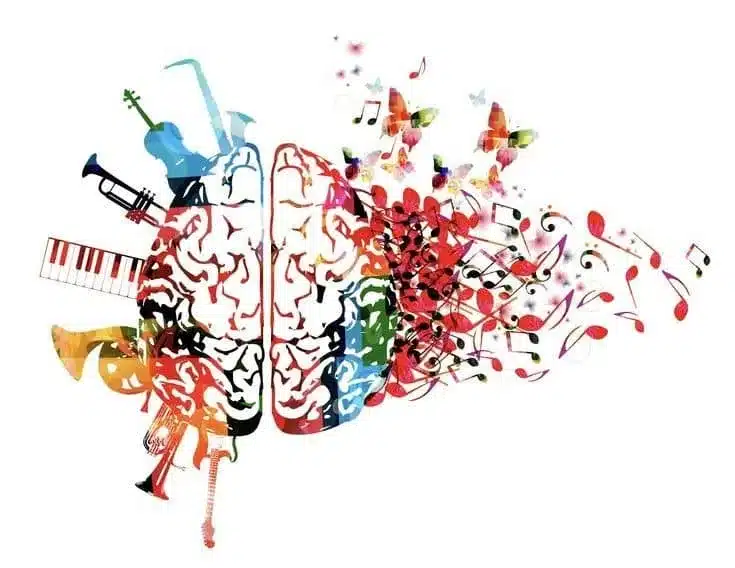
The left hemisphere tends to analyze structure, timing, and sequence, while the right hemisphere is more involved in melody, timbre, and emotional nuance. This bilateral engagement is one reason music feels rich and immersive rather than informational.
Because multiple neural pathways are involved, music is harder to ignore than many other sounds. Even background music can subtly influence mood and attention without conscious awareness.
Rhythm, prediction, and neural timing
The brain is constantly predicting what will happen next. Rhythm provides a temporal framework that allows the brain to anticipate future beats. When predictions are met, the brain experiences stability. When predictions are slightly violated, attention increases.
This balance between expectation and surprise is central to musical enjoyment. Too much predictability becomes boring. Too much unpredictability becomes stressful. Effective music sits in the sweet spot between the two.
This same mechanism explains why rhythm-based group activities feel engaging. When people move or respond to music together, their brains synchronize timing predictions, creating a shared cognitive experience.

Why Music Triggers Emotion and Memory
Dopamine, reward circuits, and pleasure
One of the most powerful effects of music on the brain is its ability to activate reward and memory systems simultaneously.
Music activates the brain’s reward system, particularly pathways associated with dopamine release. Dopamine is often described as the pleasure chemical, but its more accurate role is anticipation and motivation.
Neuroscience studies show dopamine levels often peak just before a musical climax rather than during it. This explains why build-ups, pauses, and delayed drops feel so powerful. The pleasure comes from expecting something meaningful to arrive.
This anticipation-reward loop is why familiar songs can remain satisfying even after repeated listening. The brain remembers what is coming and enjoys the journey toward it.
Why old songs unlock vivid memories
Music has a privileged connection to memory systems, especially the hippocampus. Songs heard during emotionally charged periods of life become tightly bound to those experiences.
When you hear an old song, the brain does not retrieve the sound alone. It retrieves the emotional state, social context, and environment associated with it. This is why nostalgia can feel sudden and physical.
This effect of music on the brain becomes even stronger in structured listening environments where repetition and familiarity are intentional, such as when creating music bingo playlists with intention instead of playing songs randomly.

Why You Get Chills or Goosebumps From Music
Anticipation, surprise, and peak moments
Many listeners ask, why do I get goosebumps while listening to music? Neuroscience links chills to moments where emotional intensity, anticipation, and surprise converge.
Common triggers include sudden harmonic shifts, unexpected key changes, powerful vocal entrances, or moments of silence followed by impact. These events cause dopamine release alongside physiological arousal such as increased heart rate and skin response.
The brain interprets these moments as meaningful, not just pleasant. That meaning is what produces chills.
Individual sensitivity and musical training
Not everyone experiences chills equally. Sensitivity varies based on emotional openness, personality traits, and musical familiarity. Musicians and highly engaged listeners often experience stronger reactions because their brains recognize patterns more deeply.
Shared listening contexts amplify this effect. When anticipation is collective, emotional peaks feel stronger. This is why group experiences like hosting an engaging music bingo night often produce heightened emotional responses compared to listening alone.
How Music Affects Focus, Mood, and Stress
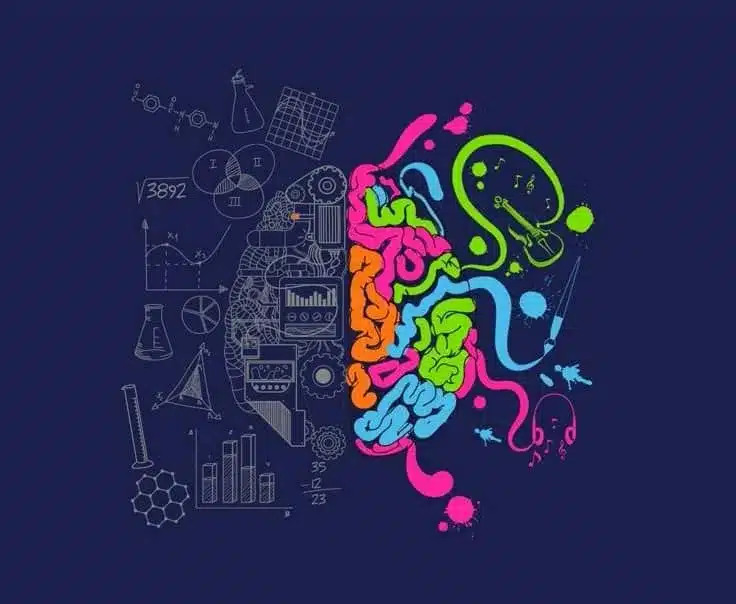
This might sound strange but do you know that the effects of music on the brain extend beyond emotion into attention, stress regulation, and mental performance?
Take Your Game Nights to the Next Level
Muzingo is a fun game where players listen to music tracks and match them to bingo cards — competing to win prizes with friends.
Play Muzingo FreeNo Card Required
Music and attention regulation
Music can either enhance or disrupt focus depending on tempo, complexity, and familiarity. Repetitive or instrumental music often supports sustained attention, while complex or lyrical music competes for cognitive resources.
The brain treats lyrics as language, which can interfere with reading or writing tasks. This is why many people instinctively switch between different music styles depending on what they are doing.
Understanding this helps listeners use music intentionally rather than accidentally sabotaging focus.
Emotional regulation and stress relief
Music influences the autonomic nervous system. Slow tempo and predictable structure can lower cortisol levels and activate calming physiological responses. Faster tempos can increase alertness and energy.
Over time, the brain forms associations between certain sounds and emotional states. This is why specific songs can reliably calm, motivate, or ground someone, even during stressful situations.
Music as a Social and Cognitive Tool
Shared music experiences and bonding
Music activates mirror neuron systems involved in empathy and social understanding. When people experience rhythm together, their neural activity can synchronize.
This synchronization fosters trust, cohesion, and a sense of belonging. It explains why music has historically been central to rituals, celebrations, and communal work.
Why interactive music experiences deepen engagement
Interactive formats transform listeners into participants. Memory recall, anticipation, decision-making, and social feedback all become part of the experience.
This is the cognitive logic behind platforms designed around participation rather than passive listening. A clear example is how structured interactive music experiences work, where sound becomes a shared cognitive activity instead of background noise.
How Understanding Music and the Brain Changes How You Listen
Listening with intention
Once you understand the effects of music on the brain, listening becomes a more conscious and deliberate act. You begin to notice how tempo shifts emotional state, how repetition creates a sense of safety, and how subtle changes in melody or rhythm trigger attention. Music stops being background noise and becomes a signal your brain actively responds to.
This awareness changes everyday listening habits. You may choose calmer music when you need focus, familiar tracks when you want comfort, or rhythm-driven songs when energy is low. Understanding the effects of music on the brain allows you to match sound to purpose, rather than letting music shape your mood by accident.
Over time, this intentional listening builds stronger emotional awareness. You recognize when a song is regulating stress, reinforcing memory, or amplifying emotion. Music becomes something you use strategically, not just something you consume passively.
Using music deliberately in social settings
his awareness extends beyond solo listening. In group environments, the effects of music on the brain influence shared attention, emotional alignment, and social bonding. Playlist structure, pacing, and moments of anticipation shape how groups respond collectively.
When music is arranged intentionally, it can guide energy in a room, encourage participation, and strengthen connection. This is why interactive formats feel more engaging than passive listening.
For a real-world example of how neuroscience-aligned design improves engagement, see the Muzingo case study.
Conclusion
The effects of music on the brain explain why music feels essential rather than optional. Music shapes emotion, memory, focus, motivation, and social connection through deeply wired neural pathways that evolved to respond to rhythm, pattern, and sound. This is why music can calm anxiety, sharpen attention, unlock memories, or energize a room without a single word being spoken.
Understanding these mechanisms does not remove the magic of music. It gives language to why the magic works. When music is chosen intentionally and experienced actively, it becomes more than entertainment. It becomes a tool for regulation, connection, and shared meaning, whether you are listening alone or engaging with others.
When viewed together, these emotional, cognitive, and social responses reveal the full effects of music on the brain in everyday life.
If you want to experience the effects of music on the brain as an active, engaging process rather than background noise, start playing a music bingo game on Muzingo and see how anticipation, memory, and shared listening work in real time.
FAQ
How does music affect the brain emotionally?
Music activates reward and emotional centers that influence mood, motivation, and emotional regulation.
Why do some songs give me chills?
Anticipation and emotional surprise trigger dopamine release and physical arousal, which the body experiences as chills or goosebumps.
Does music improve focus or reduce stress?
Yes. The effect depends on tempo, familiarity, and structure, which influence attention and nervous system response.
Is music processed differently from speech?
Yes. Music engages multiple brain systems simultaneously, making it more immersive than spoken language.
Why does music feel more powerful in groups?
Shared rhythm synchronizes brain activity and strengthens social bonding, increasing emotional intensity and connection.